
Monitoring a business in Google AI Mode begins with an apparently simple decision:
Which searches should you check?
That question deserves more thought than it might initially appear.
Repeating AI searches manually takes time. Automated monitoring can check many more prompts, but automation does not solve the problem of choosing the wrong ones.
If the searches do not represent situations faced by potential customers, the resulting visibility figures may have little commercial meaning.
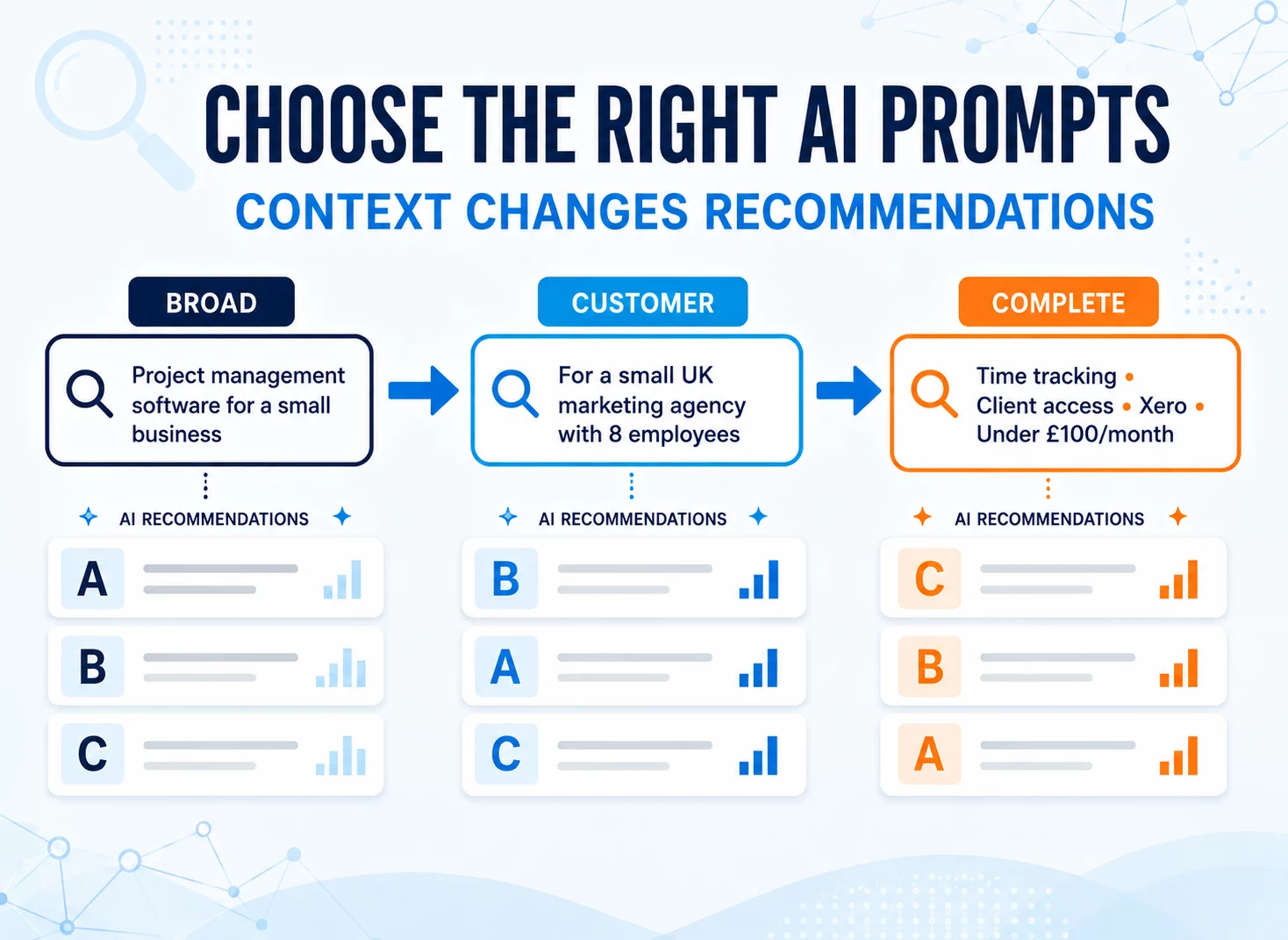
To explore this, I tested three versions of the same underlying product search. Each version contained progressively more information about the customer and what they required.
The results changed substantially—but simply making the query longer was not the decisive factor.
Start with the customer’s situation
Businesses may instinctively begin AI visibility testing with broad searches such as:
What is the best project management software for a small business?
That is relevant to a project-management company, but it tells us very little about the potential customer.
A small construction company, marketing agency and accountancy firm could all require project-management software. However, their feature requirements, existing systems and budgets may be completely different.
AI search allows someone to describe a much fuller situation. A potential customer might include:
- what type of business they operate;
- the size of their team;
- the problem they need to solve;
- essential product features;
- systems the product must work with;
- their available budget.
I wanted to see how adding this information affected the products recommended by Google AI Mode.
The three prompts I tested
I created three levels of the same project-management query.
Prompt 1: Broad
“What is the best project management software for a small business? Please present a three-option shortlist as a table just with the recommended names.”
This identified only the product category and a broad customer type.
Prompt 2: Customer-specific
“What is the best project management software for a small UK marketing agency with eight employees? Please present a three-option shortlist as a table just with the recommended names.”
This added the country, industry and team size.
Prompt 3: Complete customer situation
“I run a small UK marketing agency with eight employees. We need project management software that includes time tracking, allows clients to view project progress, integrates with Xero, and costs no more than £100 per month. Which three options should we shortlist, and why? Please present the 3 option shortlist as a table just with the recommended names.”
The complete version added functional requirements, an existing accounting platform and a strict budget.
How I conducted the comparison
I ran the broad prompt three times and the customer-specific prompt three times through Google AI Mode on 4 August 2026.
For the complete prompt, I used the first three results from my earlier ten-run experiment conducted on 3 August 2026.
Read about the 10 run AI Visibility experiment here.
For each test:
- I used the same Google account.
- Search personalisation was turned off.
- I began with a fresh Google search.
- I did not ask any follow-up questions.
- I recorded the three recommended products in the order presented.
Using three runs at each level gave me a balanced nine-response comparison.
This was an illustrative experiment, not an attempt to identify the objectively best project-management platform. I was examining how the information included in a query affected which products became visible.
Results from the broad prompt
| Position | Run 1 | Run 2 | Run 3 |
|---|---|---|---|
| 1 | monday.com | monday.com | monday.com |
| 2 | Asana | Asana | Asana |
| 3 | Trello | ClickUp | ClickUp |
The broad query produced a highly consistent top two:
- monday.com appeared first in all three responses.
- Asana appeared second in all three.
- The final position changed from Trello to ClickUp.
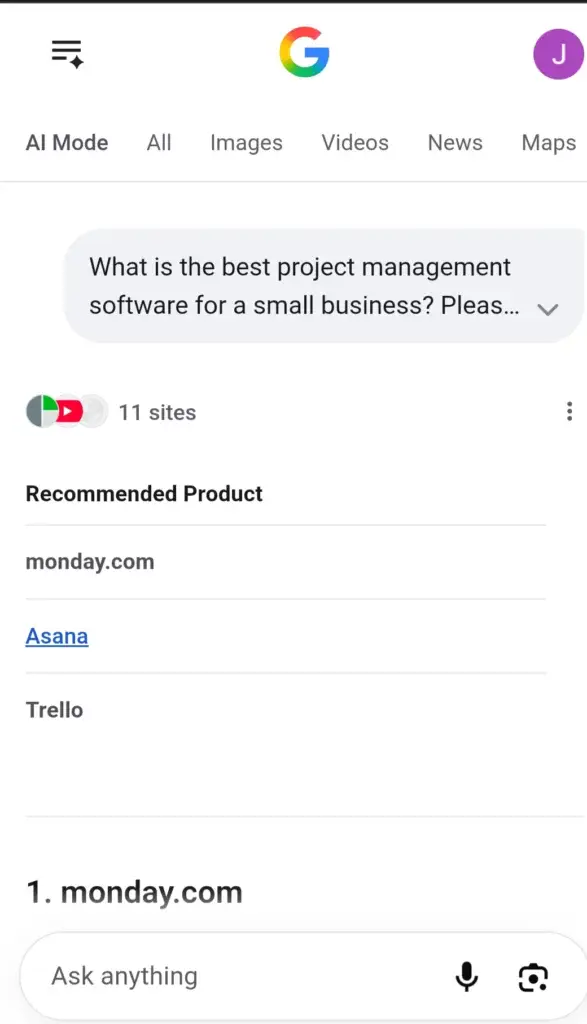
Based on these results, monday.com and Asana appeared to have very strong visibility for a general small-business project-management search.
However, AI Mode did not know whether the business needed time tracking, client access, accounting integration or any other particular capability.
The responses repeatedly invited me to provide more information, including team size, industry, preferred features, pricing requirements and integrations.
Results after identifying the customer
The second prompt specified a small UK marketing agency with eight employees.
| Position | Run 1 | Run 2 | Run 3 |
|---|---|---|---|
| 1 | monday.com | monday.com | monday.com |
| 2 | Asana | Asana | Teamwork |
| 3 | ClickUp | ClickUp | ClickUp |
Adding the customer information had a limited effect on the shortlist.
Monday.com remained first in every run, while ClickUp appeared third each time. Asana appeared twice, before Teamwork replaced it in the third response.
The explanations became more relevant to marketing-agency work. AI Mode referred to:
- campaign tracking;
- creative workflows;
- content calendars;
- designers and copywriters;
- project profitability;
- client-facing agency work.
The customer context therefore influenced how the products were described, but it did not immediately transform the main recommendations.
Once again, AI Mode asked for more information. Its follow-up questions included whether the agency required:
- time tracking;
- client access;
- particular integrations;
- budget management;
- exact pricing.
These were the kinds of requirements contained in the complete prompt.
Results from the complete customer situation
The final prompt specified time tracking, client visibility, Xero integration and a maximum total cost of £100 per month.
| Position | Run 1 | Run 2 | Run 3 |
|---|---|---|---|
| 1 | ClickUp | Xero Projects | Teamwork |
| 2 | Teamwork | Teamwork | Productive.io |
| 3 | Xero Projects | ClickUp | Paymo |
The competitive group changed considerably.
Monday.com and Asana, which had dominated the two less detailed searches, disappeared from all three responses.
Teamwork appeared every time. Xero Projects appeared twice, while Productive.io and Paymo entered the results for the first time.
Comparing visibility across the three prompt levels
| Product | Broad prompt | Customer-specific prompt | Complete prompt |
|---|---|---|---|
| monday.com | 3/3 | 3/3 | 0/3 |
| Asana | 3/3 | 2/3 | 0/3 |
| ClickUp | 2/3 | 3/3 | 2/3 |
| Trello | 1/3 | 0/3 | 0/3 |
| Teamwork | 0/3 | 1/3 | 3/3 |
| Xero Projects | 0/3 | 0/3 | 2/3 |
| Productive.io | 0/3 | 0/3 | 1/3 |
| Paymo | 0/3 | 0/3 | 1/3 |
The contrast between monday.com and Teamwork is particularly revealing.
Monday.com appeared in:
- all three broad searches;
- all three customer-specific searches;
- none of the complete-situation searches.
Teamwork followed almost the opposite pattern:
- none of the broad searches;
- one customer-specific search;
- all three complete-situation searches.
ClickUp was the only product with substantial visibility at every level.
Longer prompts are not automatically better
It would be easy to conclude that businesses should simply monitor longer searches. That is not what this experiment demonstrates.
The customer-specific prompt was longer than the broad prompt, but it produced broadly similar recommendations. It changed the explanation more than it changed the shortlist.
The greatest change occurred when I added information that could materially determine whether a product qualified:
- native time tracking;
- client visibility;
- Xero integration;
- a fixed total budget.
These were decision-relevant constraints.
A query can be very long while still containing little useful information. Equally, a relatively short query can be commercially important if it contains the one requirement that changes the available solutions.
The better principle is:
The best monitoring prompt is not necessarily the longest. It is the one containing the details that genuinely affect the customer’s decision.
A practical way to construct monitoring prompts
A business can build potential prompts from five components.
| Component | Question to answer |
|---|---|
| Customer | Who is facing the situation? |
| Problem | What are they trying to resolve? |
| Outcome | What do they need to accomplish? |
| Constraints | What requirements limit the possible solutions? |
| Decision | What are they asking AI to help them decide? |
A reusable starting structure might be:
I am [type of customer] dealing with [problem or situation]. I need [required outcome or capabilities], subject to [important constraints]. What [type of solution] should I consider, and why?
This should be treated as a thinking tool, not a rigid formula. Only include details that a genuine customer might provide and that could affect the answer.
Where can businesses find realistic prompt ideas?
The most valuable prompts should not come entirely from an internal brainstorming session.
Useful sources include:
- questions asked during sales calls;
- customer emails and enquiry forms;
- support requests;
- objections raised before a purchase;
- searches appearing in Google Search Console;
- internal website searches;
- customer and competitor reviews;
- industry forums and discussion groups;
- questions repeatedly answered by sales teams;
- problems described by existing customers.
One particularly useful question to ask customer-facing staff is:
What does someone normally tell us just before we realise that our product or service could help them?
The answer may contain the basis of a commercially meaningful AI search prompt.
Would appearing in the response actually matter?
Not every mention or citation has equal value.
During my earlier project-management experiment, an accountancy website appeared as a source because it contained information about Xero pricing. However, the person asking the question was looking for project-management software, not accountancy services.
That citation may have created some visibility, but it was unlikely to generate a relevant accountancy enquiry.
Before adding a prompt to a monitoring list, ask:
If my business appeared in the ideal way within this answer, would the person asking the question be a plausible customer?
If the answer is no, the prompt may have limited commercial importance even if it produces mentions or citations.
Start with a small core set
Manual testing becomes time-consuming surprisingly quickly. A business does not need to begin by monitoring dozens of imagined query variations.
A sensible starting point might be five core prompts covering different stages of the customer journey:
- A problem-recognition prompt.
- A broad solution-discovery prompt.
- A situation-specific recommendation prompt.
- A comparison prompt.
- A final suitability or purchase-check prompt.
Pilot each one before adding it to regular monitoring.
Check whether it:
- produces responses relevant to the business;
- reflects a believable customer situation;
- reveals meaningful competitors;
- could influence a commercial decision;
- remains useful enough to repeat over time.
Once the core list has been chosen, keep the wording unchanged when measuring trends. Continually rewriting a monitored prompt makes comparisons between different testing periods less meaningful.
New exploratory prompts can still be tested separately.
Automation cannot choose the strategy for you
An automated AI visibility platform can make repeated testing much more efficient. It can potentially record appearances, competitors, citations and changes across many prompts and platforms.
However, the resulting reports are only as useful as the prompts being monitored.
A system could check hundreds of loosely relevant searches and produce impressive charts without revealing whether the business appears when genuine potential customers need it.
Automating the wrong prompts only measures the wrong things more efficiently.
The strategic work comes first:
- understand the customer;
- identify the situations the business resolves;
- select the details that influence the decision;
- decide which searches would have real commercial value;
- then monitor those prompts consistently.
What this experiment showed
The broad prompt produced familiar general-purpose platforms.
Adding the customer’s industry, country and team size changed the explanations but had only a modest effect on the shortlist.
Adding the functional requirements, integration and budget produced an almost entirely different competitive group.
This does not establish that every detailed AI query will behave in the same way. The experiment covered one product category, one customer scenario and three runs at each prompt level.
It does demonstrate why prompt selection cannot be treated as an afterthought.
Before asking whether a business is visible in AI search, we first need to ask:
Visible for which customer, facing which problem, with which requirements, while making which decision?
Only then does the resulting measurement begin to tell us something commercially useful.
Testing conducted using Google AI Mode on 3 and 4 August 2026. AI-generated recommendations and Google’s interface may change over time.