
If you run a small business and keep hearing about AI search, AI visibility, ChatGPT, Google AI Mode and AI recommendations, it can be difficult to know what you are actually supposed to do about any of it.
Do you need new software?
Should you hire an agency?
Do you need to rewrite your website?
Should you be tracking hundreds of AI searches?
My suggestion is much simpler:
Start by spending an afternoon using AI search yourself.
You do not need to become an AI expert. You do not need to understand how large language models work at a technical level.
But I do think AI search is becoming too important for a business owner to completely ignore it or simply hand everything over to somebody else without first understanding the basics.
Before you spend money on tools, consultants or agencies, get your hands dirty.
See what AI search actually does.
First, Understand One Important Thing: AI Search Is Not a Fixed List of Results
Traditional Google search trained us to think in terms of rankings.
Search for something and you might see:
- Business A
- Business B
- Business C
Search again and you would usually expect something broadly similar.
AI search is different.
I like to think of it using a box of business cards.
Imagine there is a large box containing business cards for companies that might potentially answer a customer’s question.
When somebody asks an AI system for recommendations, it doesn’t necessarily pull exactly the same cards out of the box every time.
Certain businesses might appear frequently.
Some may occasionally appear.
Others might appear only when the question is worded in a particular way.
Change what the customer asks, and you may effectively change which part of the box the AI searches.
That analogy isn’t intended as a technical explanation of exactly how an AI model works.
Its purpose is to establish one crucial idea:
AI search results can vary.
Once you understand that, AI visibility starts making much more sense.
Your First AI Visibility Exercise Doesn’t Need to Be Complicated
For this exercise, I would use Google AI Mode and think about questions that real customers might ask before choosing a business like yours.
Don’t worry about whether you have created the perfect “prompt”.
Ask normal questions.
If you run an accountancy practice, for example, you might ask:
Which accountants in Birmingham are suitable for a small manufacturing company with 25 employees?
Then try something more specific:
Which Birmingham accountants could help a profitable manufacturing company that is struggling with cash flow?
Or:
I run a small manufacturing company in Birmingham, use Xero and need monthly management accounts and cash-flow forecasting. Which accountants should I consider?
You can do the equivalent for almost any industry.
A dentist might test questions about nervous patients.
A solicitor might test questions involving a particular legal problem.
A cleaning company might test questions about specialist cleaning requirements.
A software company might test questions involving a particular combination of customer needs.
The important thing is that these should resemble real situations your potential customers could face.
Don’t Just Look at Which Businesses Are Recommended
This is where the exercise becomes more useful.
When Google AI Mode produces an answer, don’t simply scan the business names and move on.
Read the response properly.
I recommend using the copy button beneath the AI response and pasting the result into Word, Google Docs or another document.
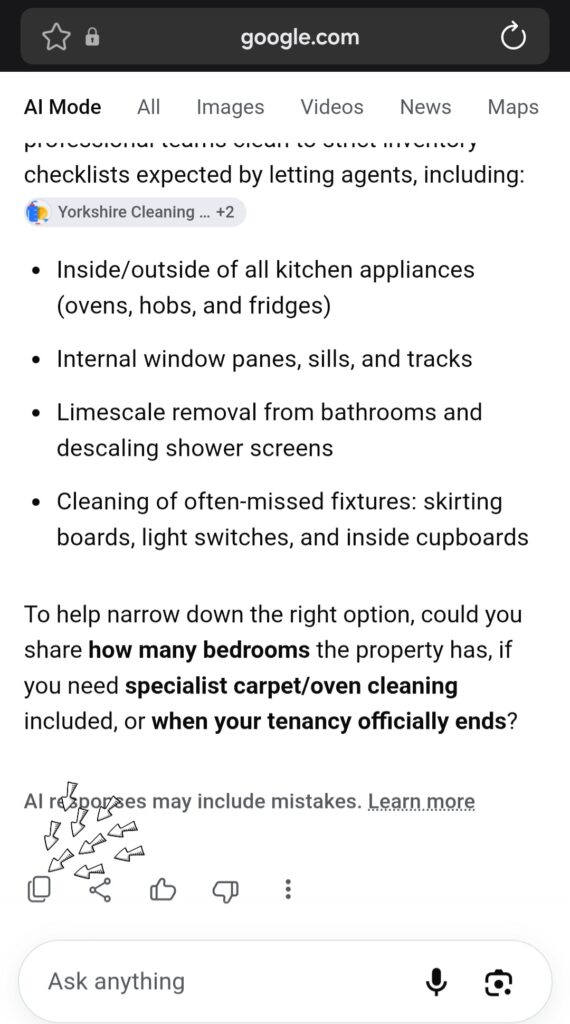
That gives you something you can examine rather than something you quickly scroll past.
Look at:
- which businesses were mentioned;
- what the AI actually said about them;
- what characteristics appeared to matter;
- which parts of the answer had links or references attached;
- which websites were being referred to.
Then start opening those sources.
Read the Pages the AI Is Referring To
This is one of the most useful parts of the whole exercise.
Suppose an AI response recommends a competitor.
Open the pages associated with that part of the answer.
What do they actually say?
Perhaps the competitor has a detailed page explaining its experience with manufacturing businesses.
Perhaps an independent website discusses them.
Perhaps a review mentions exactly the service you asked about.
Perhaps the source seems surprisingly unrelated.
You are not trying to reverse-engineer Google’s algorithm.
You are simply beginning to understand the relationship between:
the customer’s question → the AI’s answer → the businesses mentioned → the information available on the web.
Do this enough times and AI visibility becomes considerably less abstract.
Now Change the Question
Next, make small changes to your original query.
This is important because customers rarely ask exactly the same question.
Take:
Which accountants in Birmingham are suitable for a small manufacturing company?
Then change it to:
Which accountants in Birmingham are suitable for a small manufacturing company that uses Xero?
Then:
Which accountants in Birmingham could help a manufacturing business improve cash flow?
Then:
Which accountants in Birmingham offer fixed monthly fees to manufacturing businesses?
Look at what changes.
Do the same businesses continue to appear?
Does one business suddenly become much more relevant?
Are different sources used?
Does the AI emphasise completely different things?
This starts to demonstrate something that I think is fundamental to understanding AI visibility:
A business isn’t simply “visible” or “not visible”. Its visibility can depend on what the customer is actually asking for.
Repeat a Few Searches Later
You don’t need to turn this into a scientific experiment.
For now, you’re simply learning.
Run some of the same questions again later in the day or on another day.
Save those responses too.
Compare them.
You may find the businesses mentioned change.
The wording may change.
The order of recommendations may change.
Different websites may be referred to.
Some things may remain surprisingly consistent.
The objective at this stage isn’t to calculate a precise AI Share of Voice percentage.
It’s to experience the variability yourself.
Reading about AI search being probabilistic is one thing.
Seeing the same question produce different results makes the idea much easier to understand.
Then Ask AI Search About Your Own Business
I think this could be the most valuable part of the afternoon.
Start asking Google AI Mode questions about your business.
For example:
What does [Business Name] do?
What types of customers does [Business Name] work with?
Does [Business Name] provide [specific service]?
Who is [Business Name] best suited to?
What are the strengths and weaknesses of using [Business Name]?
How does [Business Name] compare with [Competitor]?
Then read the answers carefully.
Don’t just look for whether the AI says nice things about you.
Ask a more important question:
Is this an accurate description of my business?
You may discover that it is.
But you may also find surprises.
Perhaps an old service you stopped providing years ago still appears online.
Perhaps the AI describes you as a generalist when you consider yourself a specialist.
Perhaps an important part of your service isn’t mentioned at all.
Perhaps it thinks you work with a different type of customer from the one you actually target.
Perhaps competitors are being recommended for a service that you provide just as well — but your website doesn’t explain that very clearly.
Those observations give you somewhere useful to start.
Don’t Panic If the Answers Aren’t What You Expected
The purpose of this exercise isn’t to achieve perfect AI visibility in an afternoon.
It is to establish a baseline understanding.
If AI search misunderstands your business, that does not automatically tell you why.
There could be information on your website that needs improving.
There may be outdated information elsewhere online.
Competitors may have stronger evidence supporting their expertise.
Your business might simply not be mentioned much outside its own website.
Or the AI response you saw may just be one of several plausible responses to that particular question.
At this stage, you don’t need to diagnose everything.
You are learning what questions to ask.
What You Should Understand by the End of the Afternoon
After a few hours of doing this, I would hope a small-business owner understands four things.
1. AI search results can change
You shouldn’t assume one search result represents a permanent answer.
2. Changing the customer’s question can change which businesses appear
AI visibility is connected to customer needs, not simply whether your company ranks for a particular keyword.
3. AI systems use information from around the web
Your own website matters, but so can reviews, directories, articles, discussions and other third-party sources.
4. AI may not understand your business in the way you expect
And unless you check, you may never know.
That, for me, is enough to reach first base.
What Should You Do After That?
Only after doing this exercise would I start thinking seriously about the next step.
You might decide that you only care about five or ten important customer questions and are perfectly happy checking them manually.
You might decide you want an AI visibility monitoring tool to repeat the searches and organise the results for you.
You might give responsibility for it to somebody within the business.
Or you might decide that the subject is important enough to get outside help from a consultant or agency.
There is nothing wrong with outsourcing AI visibility work.
My concern is outsourcing something you don’t understand at all.
If somebody tells you:
“Your AI Share of Voice increased from 8% to 13% this month.”
you should have enough understanding to ask:
Across which questions?
Which AI platforms?
What changed in the actual responses?
Which competitors appeared?
Which sources were being used?
And, most importantly, does any of this relate to the customers we actually want?
A few hours spent experimenting yourself makes those questions much easier to ask.
You Don’t Need to Become an AI Search Expert
That isn’t the objective.
If you run a small business, you already have enough things demanding your attention.
But there is a considerable difference between:
“I don’t understand AI visibility, so somebody else can deal with it.”
and:
“I understand the basic mechanics, I’ve seen what AI search says about my market and my business, and now I can make an informed decision about what to do next.”
I think the second position is becoming increasingly important.
So if you’re wondering where to begin with AI visibility, don’t start with software.
Don’t start with an agency.
Don’t start by rewriting your entire website.
Start by asking some questions.
Save the answers.
Read the sources.
Change the questions.
Ask them again.
Then ask AI search about your own business.
Spend one afternoon getting a feel for how the whole thing behaves.
You will probably understand far more about AI visibility at the end of those few hours than you did at the beginning.
And from there, you can decide what — if anything — your business should do next.