
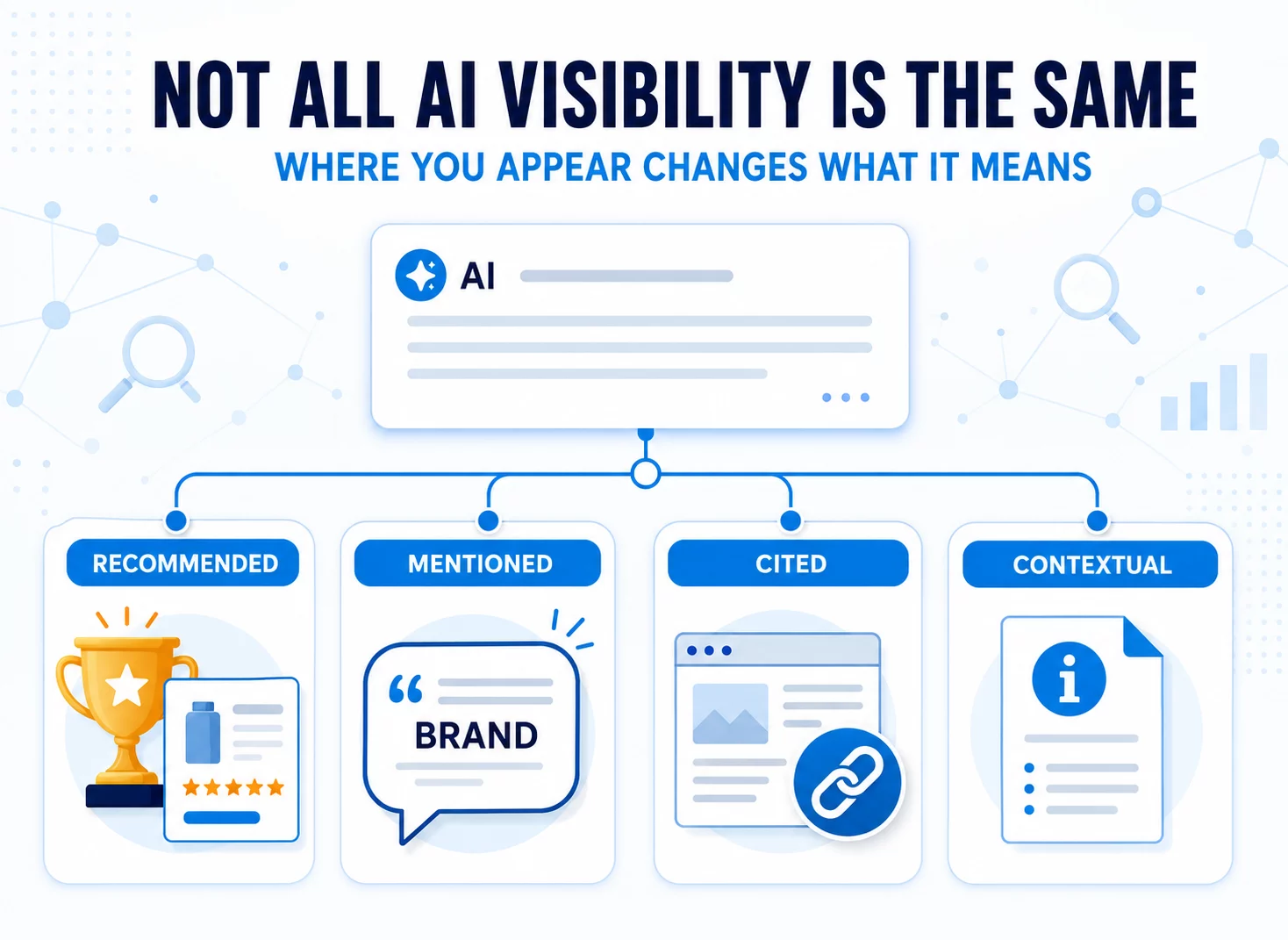
When a business appears in an AI-generated response, it is tempting to record that as a successful visibility result.
But what does “appeared” actually mean?
The business might have been:
- recommended as a solution;
- named somewhere in the answer;
- linked as a supporting source;
- mentioned only because it integrates with another product;
- used to confirm a single fact;
- cited without being commercially relevant to the person searching.
Those appearances are not equally valuable.
To explore the distinction, I examined one complete Google AI Mode response and recorded the webpages linked at each point in the answer.
The query used
I reused the detailed project-management prompt from my earlier experiments:
“I run a small UK marketing agency with eight employees. We need project management software that includes time tracking, allows clients to view project progress, integrates with Xero, and costs no more than £100 per month. Which three options should we shortlist, and why? Please present the 3 option shortlist as a table just with the recommended names.”
The earlier ten-run experiment showed how frequently the recommended products changed.
This time, I was not measuring variability. I ran the query once and examined the different roles played by the businesses and websites appearing in the response.
The shortlist
Google AI Mode opened with:
“The three project management options that meet your exact criteria for a team of eight are Paymo, Teamwork.com, and Avaza.”
It then presented:
- Paymo
- Teamwork.com
- Avaza
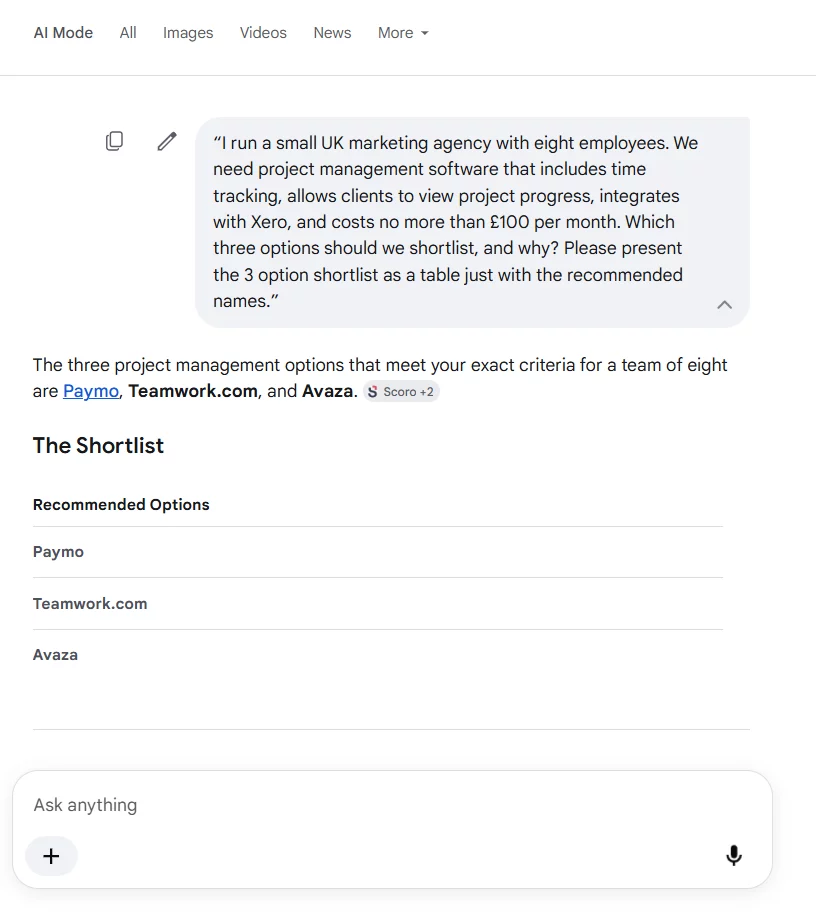
All three products received recommendation visibility. They were presented as possible solutions to the potential customer’s requirements.
That is the clearest commercially relevant appearance in the response.
However, examining the linked sources revealed that the three recommended products did not receive the same kind of supporting visibility.
One response contained many more sources than recommendations
I copied the links displayed at each citation point in the answer.
The response contained:
- 33 displayed link instances;
- 24 different linked pages after removing repeated URLs;
- approximately 18 different domains;
- three recommended products.
Some pages appeared more than once because Google associated them with several parts of the response.
The source list included:
- official product pages;
- software review websites;
- comparison articles;
- competing software providers;
- Xero’s own website and app marketplace;
- YouTube videos;
- general work-management articles.
A business could therefore be present in this answer without being one of the three recommended solutions.
Paymo received recommendation and source visibility
Paymo ranked first in the shortlist.
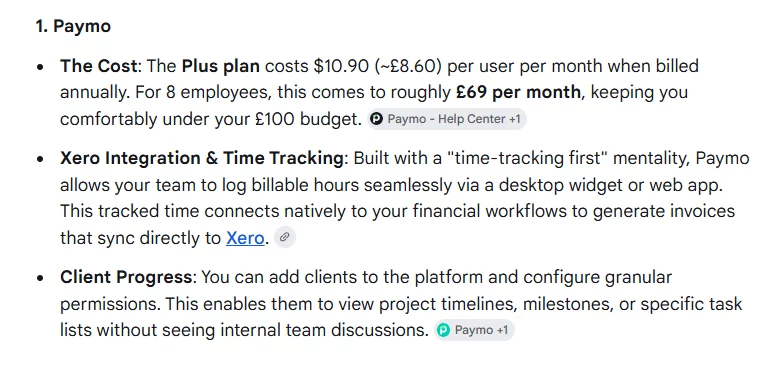
AI Mode stated:
“The Plus plan costs $10.90…per user per month when billed annually.”
Google displayed two pricing sources alongside that claim:
Paymo’s own help page currently lists the annual Plus plan at $10.90 per user per month, so the official website was directly visible alongside the recommendation.
AI Mode also described Paymo as having a:
“time-tracking first” mentality
and linked to pages from SaaSRat, UseReviews, Scoro and LinkedIn.
For the client-progress section, the displayed sources included:
- Paymo’s project-management and time-tracking page
- Paymo’s complete feature list
- articles from SmartTask, Teamwork and Teamcamp.
Paymo therefore received several forms of visibility:
- first-position recommendation visibility;
- brand mention visibility;
- official website citation visibility;
- third-party coverage supporting its inclusion.
Teamwork appeared in several different roles
Teamwork ranked second.
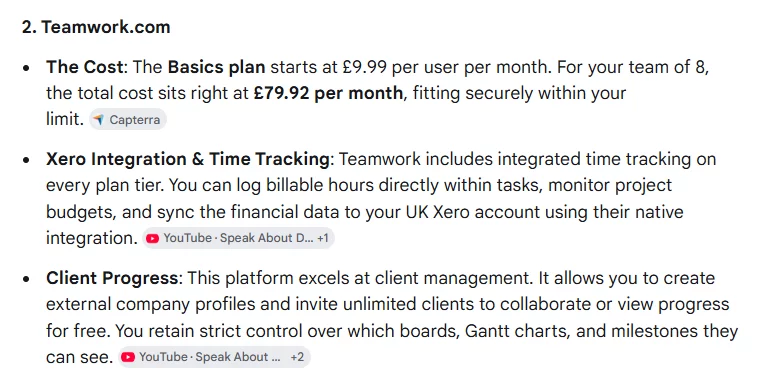
The response described it as a platform that:
“excels at client management”
and said it allowed unlimited clients to collaborate or view progress without additional cost.
Among the supporting links was Teamwork’s official client project management page. That page says customers can “add unlimited clients” at no extra cost while controlling what they can see.
Teamwork therefore received recommendation visibility and official source visibility.
However, Teamwork had already appeared elsewhere in the response. A Teamwork blog article was displayed among the sources supporting the section about Paymo’s client-progress capabilities:
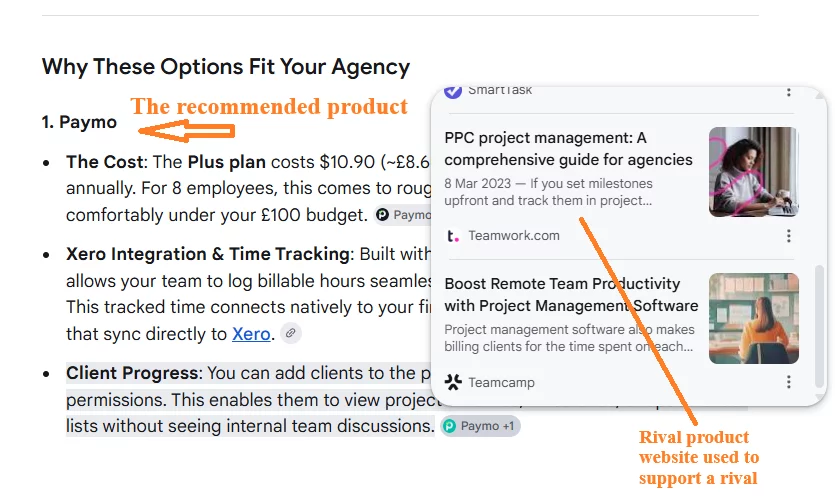
This creates an interesting crossover.
Teamwork appeared:
- as a recommended product;
- through its official product page;
- as a publishing source within a competitor’s section.
A tool counting every appearance might report several instances of Teamwork visibility. Those instances do not all mean the same thing.
Avaza was recommended without an Avaza page being displayed
Avaza ranked third.
AI Mode said:
“Avaza is specifically engineered for professional service agencies.”
It also described Avaza’s time tracking, Xero integration, client access and pricing.
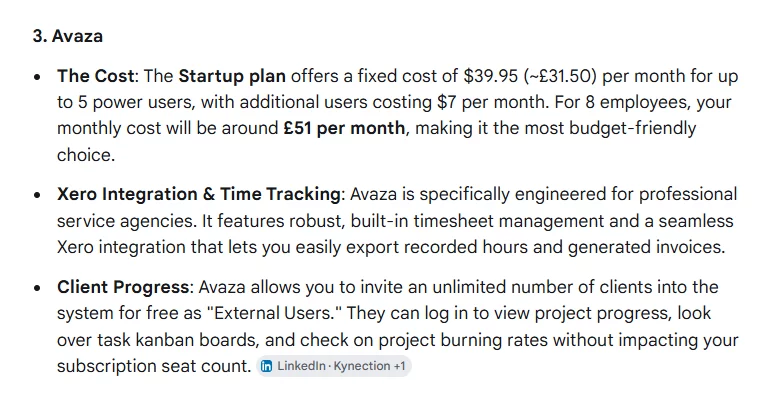
However, none of the source links I recorded came from Avaza’s own domain.
Instead, the sources displayed after the Avaza section included:
- a LinkedIn comparison article;
- a Bonsai article about Xero-compatible project-management software;
- a DaxRM comparison;
- a Planyard article;
- a Xero time-tracking page.
The opening paragraph also linked to Scoro’s comparison of project-management software that integrates with Xero. That article includes both Avaza and Paymo among several products.
Avaza therefore received strong recommendation visibility but no obvious official-domain citation visibility in this response.
This demonstrates an important distinction:
A product can be recommended even when its own website is not displayed as a supporting source.
A cited business is not necessarily a recommended business
Scoro was not included in the three-product shortlist, but its website was one of the first sources displayed.
That gives Scoro citation visibility rather than recommendation visibility.
The commercial value is not necessarily zero. Someone could follow Scoro’s comparison article, see that Scoro itself offers project-management software and explore it as another possible solution.
Other source websites played different roles.
G2 and Capterra publish software information and comparisons, so being cited within a software-selection response closely matches their purpose.
A general article may simply have supplied one supporting fact. Its publisher might receive a link without being presented as a solution to the searcher’s underlying problem.
This is why raw citation numbers require context.
Xero had contextual visibility
Xero appeared throughout the response because integration with Xero was part of the original query.
Google displayed several Xero pages, including:
- the Projectworks listing in the Xero App Store
- Xero’s time-tracking page
- Xero Projects
- Xero’s small-business time-tracking guide
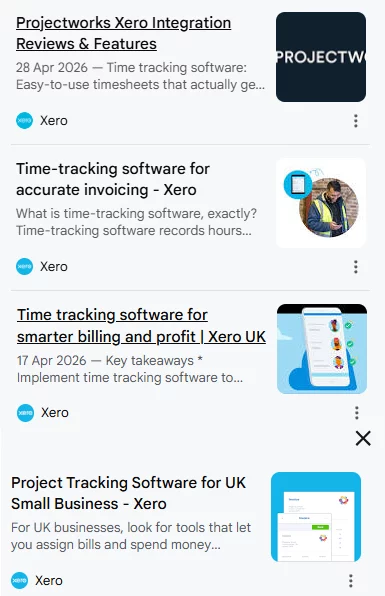
Xero was highly visible as the accounting platform the recommended products needed to work with. It was not, however, one of the three shortlisted project-management options in this response.
Its role was primarily contextual:
- a required integration;
- a source of supporting information;
- the host of an integration marketplace.
That is different from Paymo, Teamwork and Avaza being presented as the answer to the customer’s purchasing question.
Citation visibility does not automatically validate a claim
Some source associations deserve caution.
For example, the Teamwork integration section displayed a Xero App Store page for Projectworks and a Xero Projects time-tracking page.
Based on their page titles and URLs, neither is obviously an official Teamwork integration page.
Similarly, Avaza’s pricing and integration claims were not accompanied by an obvious official Avaza source.
This does not automatically prove that the generated claims were wrong. It does show that the presence of several citations should not be treated as confirmation that every linked page directly supports every statement beside it.
A full assessment would require opening each page and checking the relevant claim. That would be a separate citation-accuracy experiment.
The purpose of this test was to identify the different roles businesses and websites occupied within the response.
Four useful visibility categories
The response suggests four broad categories.
| Visibility type | What it means | Example from the test |
|---|---|---|
| Recommendation visibility | Presented as a suitable solution | Paymo, Teamwork and Avaza |
| Mention visibility | Named within the generated answer | Xero |
| Citation visibility | A webpage is displayed as supporting material | Scoro, G2 and Capterra |
| Contextual visibility | Helps explain part of the answer without resolving the main need | Some Xero and general work-management sources |
These categories can overlap.
Teamwork was recommended, named and cited. Avaza was recommended and named, but its own website was not visibly cited. Scoro was cited but not recommended.
Commercial relevance matters
Consider two possible appearances for an accountancy firm.
In the first response, its page is cited to confirm the price of a Xero feature within a project-management software comparison.
In the second, the firm is recommended to a business owner searching for help resolving a Xero reporting problem.
Both could be recorded as AI visibility, but only the second places the firm directly in front of someone who may need its services.
A useful question is:
If someone followed this appearance, would they be a plausible customer for the business?
Recommendation visibility within a commercially relevant prompt is usually more closely connected to a buying decision than an incidental supporting citation.
Citation visibility may still provide exposure, authority or website visits. It should simply not be assumed to have the same value.
What should a monitoring report distinguish?
A useful AI visibility report should ideally separate:
- recommendations;
- mentions;
- citations;
- recommendation positions;
- official-domain citations;
- third-party sources discussing the brand;
- competitors;
- context and sentiment;
- commercially important prompts.
Otherwise, a statement such as:
“Your business appeared 50 times”
may tell us very little.
Was it recommended 50 times? Was its website cited for a minor statistic? Was it mentioned negatively? Did the searches come from situations connected to what the business sells?
The total only becomes meaningful when the role and context are understood.
Limitations of this test
This experiment examined one response to one query on one AI platform.
It did not attempt to:
- verify every generated product claim;
- assess the quality of all 24 linked pages;
- establish permanent visibility levels;
- determine why Google selected each source;
- measure how frequently each appearance type occurs.
It provides a worked example of the different roles businesses can occupy within one AI-generated answer.
The practical conclusion
AI visibility is not a single yes-or-no measurement.
In this response:
- Paymo, Teamwork and Avaza were recommended;
- Paymo and Teamwork also received official website citation visibility;
- Avaza was recommended without an obvious Avaza page being displayed;
- Scoro received citation visibility without being shortlisted;
- Xero received extensive contextual and source visibility;
- several review and comparison websites supplied supporting information.
The commercially important question is therefore not merely:
“Did the business appear?”
It is:
“Where did the business appear, what role did it play, and was that appearance relevant to the customer’s decision?”
Understanding that distinction is essential before attempting to calculate AI visibility or recommendation share of voice.